
Read a sample chapter
The Day the Heir Became King
Aigai · Vergina · 336 BCE
Does a kingdom pass through blood, institutions or public acceptance?
A kingdom assembled in one place
In 336 BCE the Macedonian court gathered at Aigai for the marriage of Philip II's daughter Cleopatra to Alexander I of Epirus. The celebration displayed a dynasty at the height of its power: Philip had defeated the principal Greek resistance, established leadership over a Greek coalition and was preparing war against the Persian Empire.
Aigai was the appropriate stage. Although Pella had become the principal administrative center, Aigai remained the ancestral and ceremonial heart of the monarchy. During the festivities Philip was killed by Pausanias, one of his bodyguards. Alexander was approximately twenty years old and inherited obedience that was not yet guaranteed.
Set the map and timeline
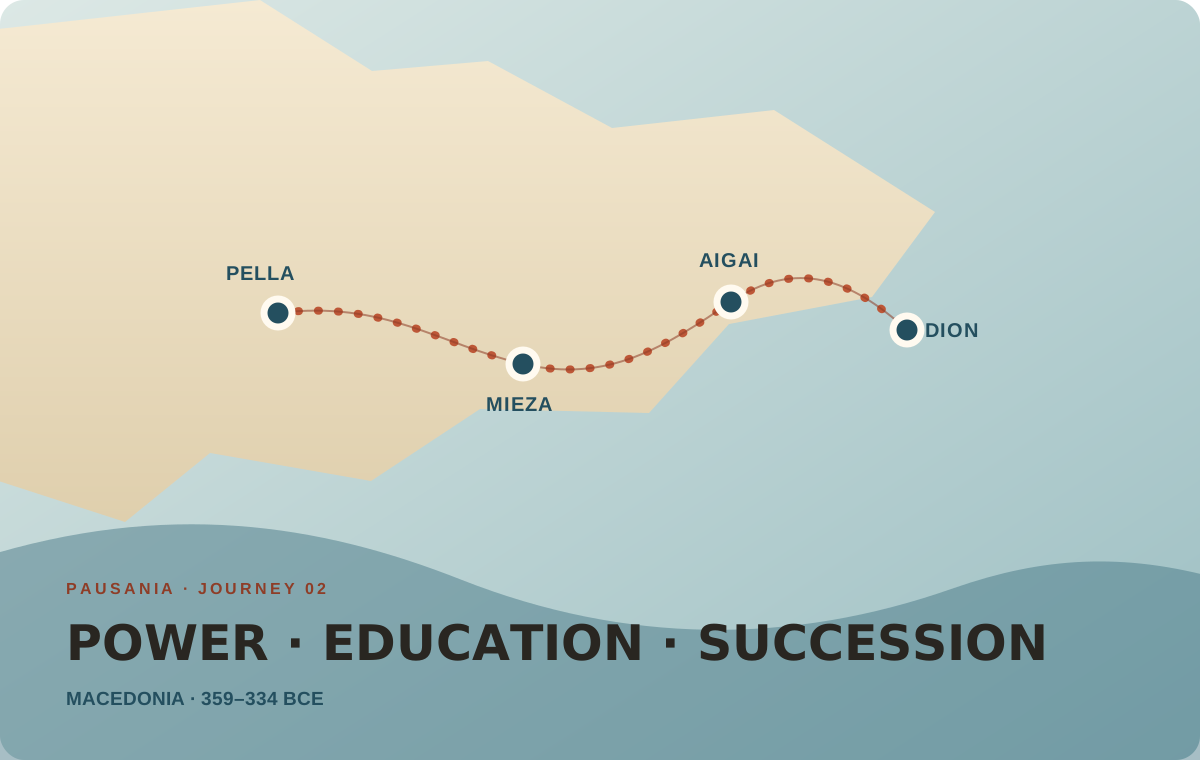
Place the palace, theatre and royal burial ground within one ceremonial landscape, then look outward to Pella, Dion, Corinth and the Macedonian force already operating in Asia. The assassination was not an isolated palace drama: it happened while Philip's project was expanding beyond Macedonia.
- 359 BCE — Philip becomes king
- 338 BCE — Macedonian victory at Chaeronea
- 337/336 BCE — preparations for the Persian campaign
- 336 BCE — Philip is assassinated and Alexander succeeds him
- 334 BCE — Alexander crosses into Asia
Read two different kinds of testimony
Aristotle, a contemporary of Philip and Alexander, mentions the assassination briefly in Politics. He associates Pausanias's act with an injury involving Attalus and Philip's failure to provide redress. The account is early, but terse and written to illustrate a political argument.
Diodorus, writing centuries later, gives a vivid ceremonial scene: Philip enters the theatre before the crowd, separated from his guards, and Pausanias strikes. Its detail should not be silently treated as eyewitness reporting. The secure core is that Pausanias killed Philip at Aigai; wider theories of conspiracy remain unresolved.
Read the physical setting
The elevated palace, the theatre below it and the royal tombs reveal different dimensions of kingship. Courts and dining spaces organized elite relationships; the theatre made an assembled political community visible; weapons, metalwork and wall paintings converted status, military power and dynasty into enduring memory.
The architecture helps explain why a public killing could become a political crisis, but it cannot confirm every detail of Diodorus's scene. Archaeology preserves spaces and objects, not the crowd's fear, negotiation or acclamation.
- Notice the palace's scale, elevation and visibility.
- Compare controlled palace courts with the collective space of the theatre.
- Ask what weapons, banqueting vessels and paintings claim about royal authority.
- Separate what the site demonstrates from what later narrative supplies.
Inheritance was not control
Alexander inherited a reorganized army, experienced commanders, substantial resources, a strengthened monarchy, a Greek coalition and preparations for an Asian campaign. He did not need to invent Macedonian power.
He still had to secure recognition, neutralize dynastic rivals, reassert control over the coalition and persuade or compel experienced men to follow a young king. His first achievement was preventing Philip's political system from dissolving with Philip.
Uncertainty ledger
The evidence supports a clear event but not a complete murder solution. A responsible account preserves the gaps instead of filling them with dramatic certainty.
- Established — Pausanias killed Philip at Aigai in 336 BCE, and Alexander succeeded him.
- Approximate — the precise sequence of public recognition and private negotiation.
- Disputed — wider conspiracy theories involving Olympias, Alexander or other factions.
- Disputed — the attribution of every royal tomb; official identifications and scholarly arguments must be shown separately.
- Unsupported — naming a precise surviving space as Alexander's secure coronation room.
Before you leave
Consider three propositions: Philip made Alexander's conquests possible; Alexander made Philip's inheritance usable; neither statement is sufficient without the other. Which does the surviving landscape support most strongly?
The palace emphasizes inherited institutions. The theatre emphasizes contingency. The tombs emphasize dynasty and continuity. Only after making continuity credible could Alexander depart for Asia.