
Read a sample chapter
The Silver Decision
Laurion · Kamariza · Thorikos · 483/2 BCE
What should a city do with a windfall—and whose labor made that choice possible?
Salamis began underground
Around 483/2 BCE, Athens received an exceptional return from the silver-mining district of Laurion in southeastern Attica. Citizens faced a choice: distribute the revenue among themselves or turn it into a public capacity whose future value could not be known.
Themistocles argued for ships. The immediate persuasive context was not necessarily a precise forecast of Xerxes’s invasion but Athens’s continuing conflict with the naval power of Aegina. The fleet that later mattered at Salamis was therefore built for a present rivalry and proved decisive in a greater emergency. Beginning with the later victory already guaranteed makes the original decision look easier than it was.
Set the map and timeline
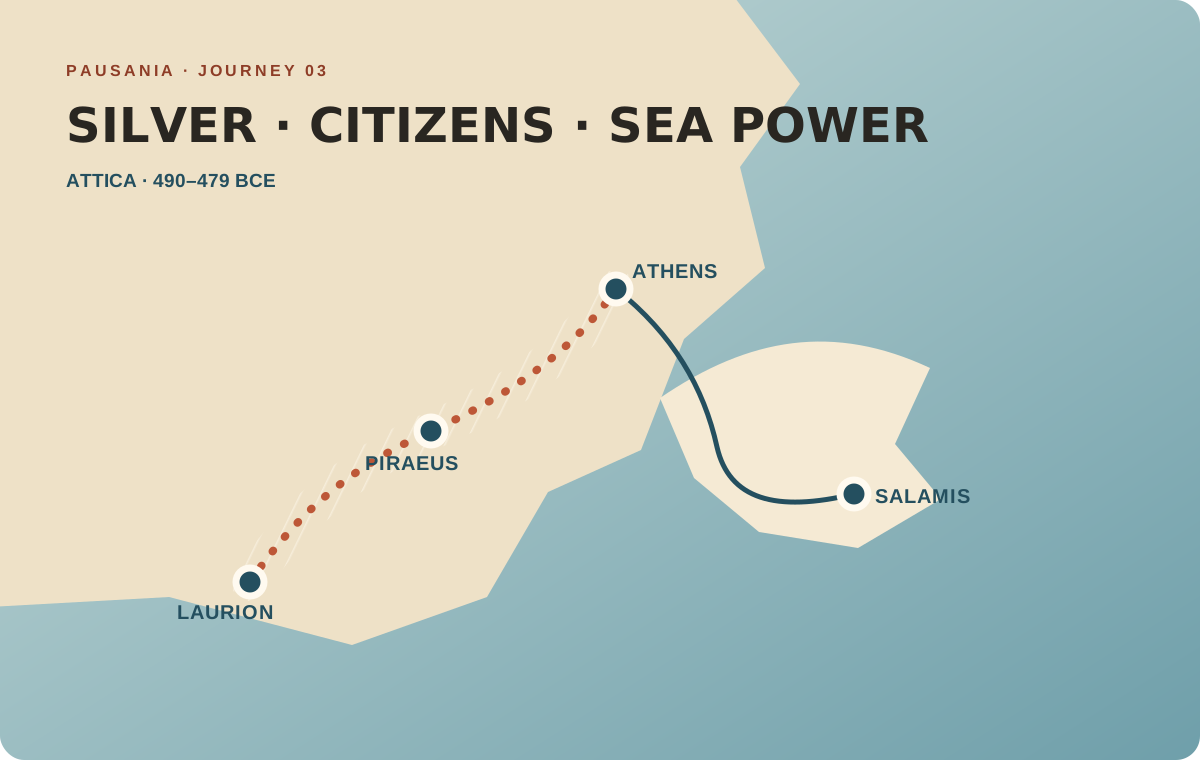
At 483 BCE, center the map on an industrial landscape rather than a single monument. Kamariza, Thorikos, Athens, Piraeus and Aegina form one connected system of geology, processing, political deliberation and naval competition. Salamis should remain visible but muted: it is a future consequence, not yet the declared purpose of every participant.
Move the timeline to 480 BCE and the same map acquires a different meaning. Athenian ships now appear inside an allied Greek fleet, while Xerxes’s force resolves into Phoenician, Egyptian, Cypriot, Carian, Ionian Greek and other contingents. The geography should make a simple “West against East” story difficult to sustain.
- 490 BCE — Athens defeats the Persian expedition at Marathon
- 483/2 BCE — Laurion revenue is redirected toward a fleet
- 480 BCE — evacuation of Attica and the battle of Salamis
- 479 BCE — the invasion is defeated on land at Plataea
Read two ancient accounts
Herodotus reports that citizens expected to receive ten drachmas each and that Themistocles persuaded them to spend the money on two hundred ships for the war with Aegina. Writing with knowledge of the later invasion, Herodotus emphasizes that these ships ultimately saved Greece.
The Constitution of the Athenians preserves a different financial procedure involving one hundred talents and one hundred wealthy Athenians responsible for producing ships. The accounts agree on the essential transformation—revenue that might have become private citizen income became naval capacity—but they do not provide an assembly transcript or settle every number and mechanism.
Read the industrial landscape
Laurion’s silver did not emerge from the ground as money. Workers followed silver-bearing lead ore through shafts and galleries, broke and transported it, crushed it, concentrated it in washing installations, smelted it into lead and separated the silver through cupellation. Mine openings, tool-cut galleries, cisterns, washeries, furnaces and slag preserve parts of that chain.
Water is one of the landscape’s least obvious protagonists. In an arid region, ore concentration depended on engineered systems for collecting, storing and reusing it. The surviving installations demonstrate a durable Classical mining system, but not every visible structure can be assigned to the fleet decision’s exact year.
- Look for the physical distance between extraction, washing and smelting.
- Notice how water management made mineral wealth usable.
- Resist turning one surviving installation into “the mine that paid for Salamis.”
Put the workers back into the story
Classical Laurion depended heavily on enslaved labor. The exact number and legal status of the people working here in 483 BCE cannot be recovered from the stonework, and figures from later authors must not be projected backward as a census. Yet a history of Athenian silver that omits coercion would be materially false.
Male citizens debated the revenue’s use. The enslaved people who produced much of that wealth had no voice in the decision; neither did women or resident foreigners. Democratic agency and exploitation were not alternative descriptions of Athens. They coexisted within the same political economy.
From silver to rowers
A trireme was not merely a wooden object. It required money, timber, maintenance, harbor infrastructure, commanders and a large trained crew capable of coordinated effort. Naval expansion increased the strategic importance of citizens who could not afford hoplite equipment but could serve as rowers.
The relationship between fleet and democracy was gradual rather than mechanical, but the causal chain matters: ore became silver, silver became public revenue, revenue became ships, and ships made thousands of citizens indispensable to Athenian power. An institution built for survival would later reshape both political confidence and imperial capacity.
Carry the decision to Salamis
Athens supplied the largest Greek naval contingent at Salamis, but it did not fight alone. Aegina—the rival that helped justify the fleet—fought beside Athens, as did Corinth, Megara and other communities. Overall command belonged to the Spartan Eurybiades. The victory emerged from a difficult coalition, not from a unified nation acting under one will.
The Achaemenid fleet was no more homogeneous. Its constituent peoples brought different maritime traditions and political relationships to imperial service. Laurion belongs in the Salamis story because it explains Athenian capacity; it does not erase the agency of allies or opponents.
What we know—and what remains uncertain
The strength of the chapter lies in keeping a secure causal argument while refusing false precision. The revenue decision, the growth of the fleet and Laurion’s dependence on organized labor are well supported. Exact totals and individual intentions are less secure.
- Established: mining revenue was redirected toward naval construction and the resulting fleet became crucial in 480 BCE.
- Ancient testimony: Herodotus presents Aegina as the immediate justification; the assembly’s exact rhetoric is unrecoverable.
- Uncertain: the exact number of ships and the precise financial mechanism.
- Unknowable: the complete private intentions of Themistocles and every citizen who supported him.
Reflection
First ask the question without hindsight: would you take a modest individual payment now, or invest it in a public capacity whose value was uncertain?
Then ask the harder question: can we admire the political foresight of the decision without hiding the people who produced the wealth but possessed no political voice? Carry both questions to Salamis. The first reveals collective agency; the second reveals the price and limits of Athenian freedom.