
Read a sample chapter
Two Worlds Called Nestor’s Palace
Palace of Nestor, Ano Englianos · Pylos · c. 1250 BCE and c. 700 BCE · two historical horizons
Is epic preserving the Bronze Age, or reinventing it for a later audience?
A young traveller asks an old survivor
Telemachus reaches Pylos because he cannot yet tell his own story. His father is absent, his household is being consumed by the suitors, and he needs someone who returned from Troy to turn rumor into knowledge. Nestor cannot tell him where Odysseus is. Instead, he receives the stranger, performs the obligations of hospitality and gives him a story about a generation broken by war and difficult returns.
Nearby, at Ano Englianos, stands the excavated centre conventionally called the Palace of Nestor. The encounter is irresistible: a named king in a canonical poem and a real Mycenaean palace in the landscape of Pylos. Pausania begins by holding them together—but not declaring them identical.
One place, two clocks
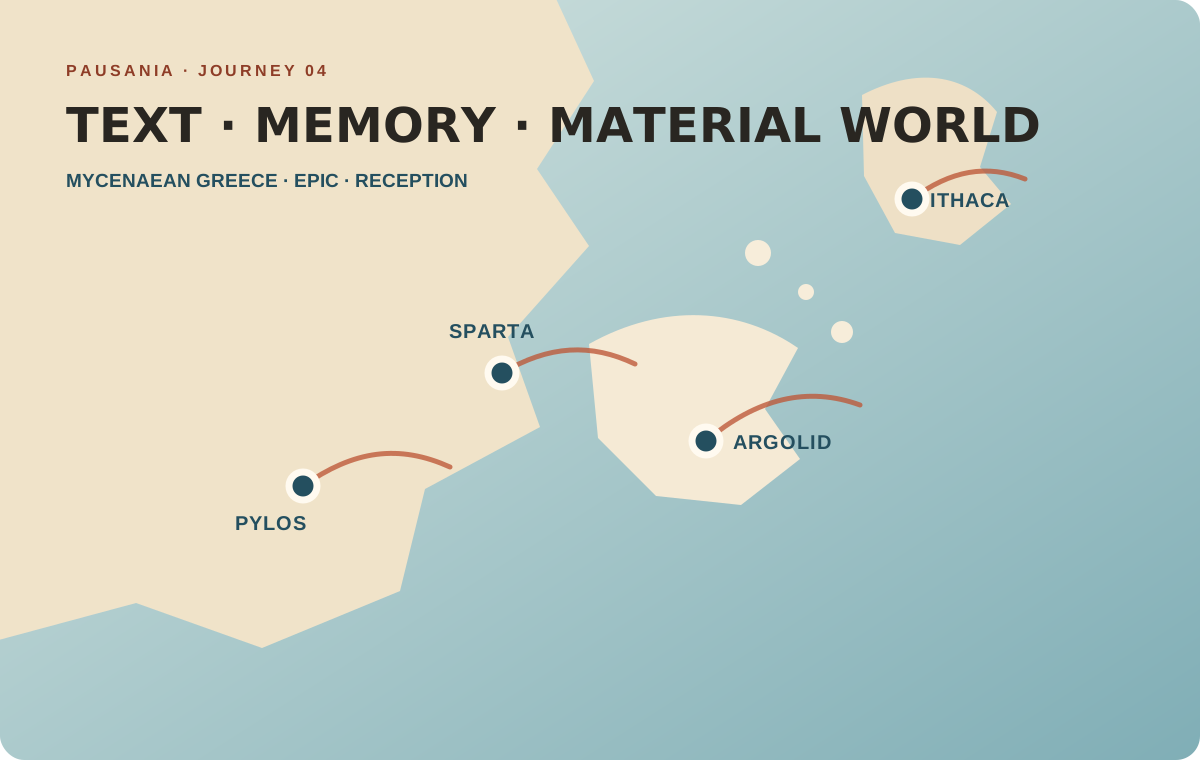
The map fixes the excavated palace on the ridge of Ano Englianos and places the coast, modern Pylos and the wider Messenian territory around it. It does not draw Telemachus’s sea passage as a documented ancient route. The poem supplies a journey within a story; archaeology supplies a settlement and political landscape.
The timeline first stops in the thirteenth century BCE, when the palace administered a Mycenaean kingdom. It then moves forward several centuries to the long formation of Greek epic and the period in which the Odyssey took monumental form. The gap is the chapter’s central evidence: the palace and poem do not belong to the same historical present.
Read the arrival before the ruins
In Book 3 of the Odyssey, Telemachus finds the Pylians gathered by the sea in a communal sacrifice to Poseidon. Athena, disguised as Mentor, teaches him to approach Nestor; the hosts make space for the strangers before demanding their identities. Hospitality is not decoration. It is the social practice that allows an unknown young man to enter a network of memory and obligation.
Nestor’s answer is expansive but incomplete. He can recount quarrels among the Greeks and the scattered returns from Troy, yet he cannot resolve Telemachus’s private question. The episode turns travel into education: the son gains no simple fact about his father, but learns how adults preserve, shape and sometimes fail to master the past.
What the palace can actually tell us
The excavated complex was an administrative centre with official and residential rooms, courts, workshops, storerooms, decorated spaces and an archive of Linear B tablets. Fire destroyed the palace around the end of the Bronze Age and unintentionally baked many clay tablets hard enough to survive. Their records reveal allocations, personnel, offerings and an organized economy—not the biography of Homer’s Nestor.
The central megaron, painted floors, hearth, storage system and archive demonstrate how authority could be staged and managed in a Mycenaean palace. They give the poem a productive comparison, not an illustration. Homeric feasting and elite households may preserve transformed memories of palatial life, while the poem’s social world also reflects centuries after the palaces disappeared.
What to notice
Move through the remains as evidence of functions and relationships rather than searching for rooms owned by literary characters.
- The route from courts into the megaron: access to authority was spatially organized.
- The monumental hearth and traces of painted decoration: ceremony belonged to political power.
- Storerooms and archive areas: the palace depended on administration as well as heroic display.
- The famous clay bathtub: a real palace object, but not proof of any bathing scene or named epic person.
- The surrounding Messenian landscape: Pylos was a territory, not only a royal residence.
What remains uncertain
The tablets do not name Homer’s Nestor, and there is no archaeological demonstration that the excavated ruler was the man of the Odyssey. “Palace of Nestor” is a conventional and meaningful modern name, not an excavated identification card. Scholars also continue to debate how much Bronze Age material survived through oral tradition and how much the epics reshape earlier memories through later institutions, objects and values.
For the same reason, this journey does not advertise a real route of Odysseus. Pylos and Sparta are identifiable settings in Telemachus’s journey, but many places in Odysseus’s wanderings resist secure location. The uncertainty is not a defect to be concealed; it is part of learning how poetry, memory and geography interact.
Before leaving Pylos
Nestor cannot give Telemachus the answer he came for, and the palace cannot prove the poem true. Both encounters still educate him—and us. Ask which is more valuable here: finding a surviving fragment of the Bronze Age inside epic, or seeing how a later society made a vanished age meaningful.